Analysis Paralysis: Can too many ideas get in the way of progress?

What do Albert Einstein, Nikola Tesla and Tim Berners-Lee all have in common? Aside from being household names in their own right, they are all known for being inventors – big thinkers of their time, sharing ideas and delivering solutions that revolutionized modern society, propelling the industrial and technological revolutions forward.
When we look back through history, our biggest leaps in advancement have come from big ideas that define the times we live in. In today's business world, the most successful companies are the ones who place creativity and thinking out of the box and at the heart of all they do. You need look no further than your immediate environment to see these companies in action – Google, Apple and Facebook, to name a few, who continue to push the envelope with new ideas and strategies, carrying us into the 4th industrial revolution of advanced technology.
But how do these companies do it? How do you know when you've had a good idea? Is it possible to tell the difference between a good idea and a bad one? And can you have too much of a good thing? Can good ideas actually get in the way of productivity? In today's blog, we're discussing the creative process, focusing on how businesses and entrepreneurs alike develop concepts, as well as how to avoid getting stuck in the ideas stage – and why this happens.
“I do not fix problems. I fix my thinking. Then problems fix themselves”
~ Louise L. Hay
Throughout my professional career – and especially since embarking as an entrepreneur with my new business, Shining Compass, I have become all too aware of the thrill and excitement of a new idea, or several new ideas. Whether it was deciding on my business name, or developing my brand, my creative energy lended well to generating thoughts about how I wanted my business to look, feel and be perceived. However, as someone who has been a project manager in my corporate career, I could also see how having too many ideas gets in the way of real progress. Without a defined process, assessment or structure, my ideas were just like clouds floating through the air.
This phenomenon, although not widely discussed, is sometimes referred to as 'analysis paralysis.' Put simply, it is defined as an inability to make a decision or take action due to over-thinking an idea or circumstance. This paralysis can occur for a number of reasons:
Having too many ideas or options to decide between
Receiving or having access to too much information to make a definitive decision
Needing to make an important decision and wanting to ensure it is the right one
So why does it happen? And how do we get clarity in these situations?
Conceptualization: The Ajna Centre
In BG5® Human Design Career Design, the Ajna center, or Conceptualization as it is also called, is where our mental awareness and consciousness is located. It plays an important role in the processing of information, forming our comprehension and awareness. It's where our vision, thoughts and insights are cultivated. When you have thoughts about the past, or ideas for the future, it's the Ajna that is driving your thoughts, flexing your mental muscle so investigate, research and analyze a given topic or idea.
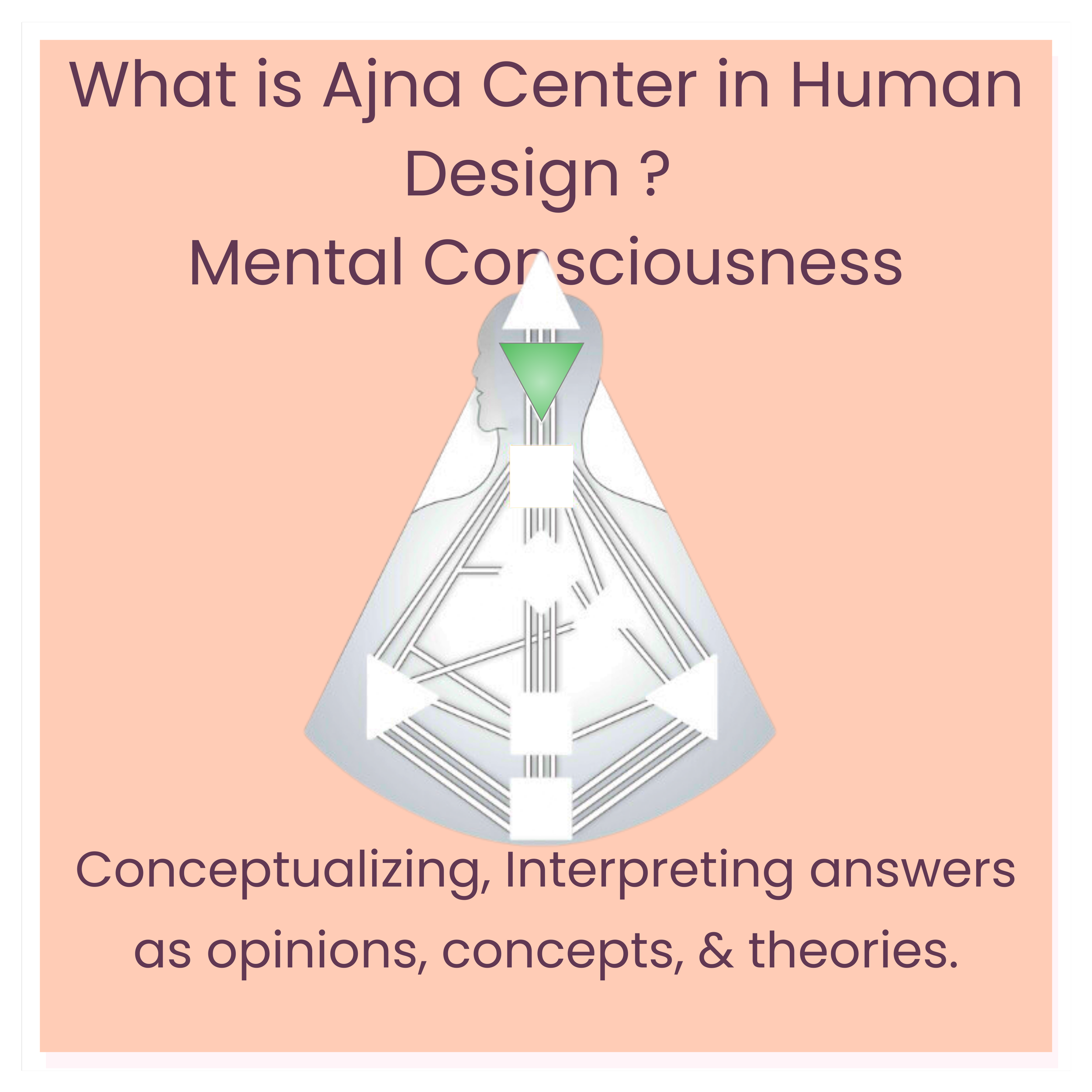
Ajna Center in Green - It is the Conceptualization Function in Human Design System
In its not-self state, an undefined Ajna uses the mind to make decisions, which as we learned in our last blog on the Head Center - Inspiration, does not always yield the best results.
An undefined Ajna in this state may feel uncertain in thought, spending vast amounts of time reviewing options and over-analyzing decisions.
They may even feel that they need to prove their intellect to those around them, which can be draining and counter-intuitive to productivity. A defined Ajna in its not-self state is no better, often finding itself obsessing over thoughts, ideas or decisions, creating mental anxiety whilst trying to figure out the right answers to everything.
If you find yourself constantly obsessing over things in your mind, seeking answers to big ticket item questions with no seeming resolution, or making questionable statements to demonstrate your certainty on a subject, then you may have an undefined Ajna. In learning about the role the Ajna plays in decision-making, it is easy to see how so many of us can get stuck in the thoughts and ideas process, without actually making it out of conceptualization and into implementation.
When we look at the Ajna in its healthy state, we can see much more surety in the mental approach and process.
Defined Ajna in this state have routine methods for thinking through problems and enjoy analyzing and researching ideas or problems in a consistent way. Undefined Ajnas in a healthy state, although having less routine and structure in their thought processes, are able to do so in a non-attached way, allowing information to flow in and out, pursuing only those thoughts which it deems to be valuable. Their mental process is much more fluid and adaptable, making them capable of moving past the concept stage and into implementation.
They may even feel that they need to prove their intellect to those around them, which can be draining and counter-intuitive to productivity.
A defined Ajna in its not-self state is no better, often finding itself obsessing over thoughts, ideas or decisions, creating mental anxiety whilst trying to figure out the right answers to everything.
“Worrying is like paying a debt you don’t owe”
~ Mark Twain
How to leverage good ideas without getting stuck
With new awareness of the Ajna and its tendencies, we can develop processes and simple tools to help us get out of the rinse-repeat cycle of mental decision-making. We become more aware of our tendencies to pursue too many ideas at once and we may be able to observe our own 'analysis paralysis' when trying to move a concept forward. Should you ever find yourself in one of these mental ruts, consider using one of these tools to help you move forward:
“We cannot solve our problems with the same level of thinking that created them”
~ Albert Einstein
If you are interested in developing your intuition, as well as learning more about where it comes from and how to harness it, then a BG5® Career Design Overview may be what you need. It is the perfect way to learn more about your innate talents and interest in the field of work, as well as discern where to invest your time, effort and energy to lead a more fulfilling life.
Set a vision for what you are trying to achieve, with clear deliverables
Break big decisions into smaller ones that help you to see the bigger picture
Research – but limit your information-gathering to pre-determined length of time or number
Get feedback from others and ask for opinions to help narrow down options
Sleep on it – if an important decision is weighing you down, take a break from it and wait for clarity
Perfect isn't always best – sometimes the way forward is not to have a perfect solution, just a solution
Observe your thoughts – if you notice your mind is in overdrive, practice a mindfulness technique to help you to refocus
So to answer the question we posed earlier, no, it's not bad to have lots of ideas. But the real key to success is being able to set parameters and defining processes that help to harness the power and potential of the mind in a way that does not stifle creativity, but instead, combines it with logical reasoning and appropriate action. Einstein, Tesla and Berners-Lee evidently had the balance right. Only you to discern the balance of these forces within your own mind.
Don't forget, ideas without momentum are just ideas, but ideas with forward motion, now...that's where the real magic happens!
If you are interested in learning more about how Ajna - conceptualization process and Inspiration shows up in your life, as well as how to maximize impact in your career, then a BG5™ Career Design Overview may be what you need. It is the perfect way to learn more about your innate talents and interests and discern where to invest your time, effort and energy to lead a more fulfilling life.

Loveleen Paintal, Founder of Shining Compass® provides consulting for individuals and businesses for personal exploration, business team dynamics and leadership.
To get started with Shining Compass Business Coaching, follow the simple steps below:
Book a free 15-minute discovery call with Shining Compass. We offer global online coaching, so location is no problem – just find a time that works for you!
During our discovery call, we will get to know each other to see if we are a good fit
If we match, select your preferred coaching option and schedule a time with your Shining Compass coach
Payments are accepted via credit card directly at time of booking